
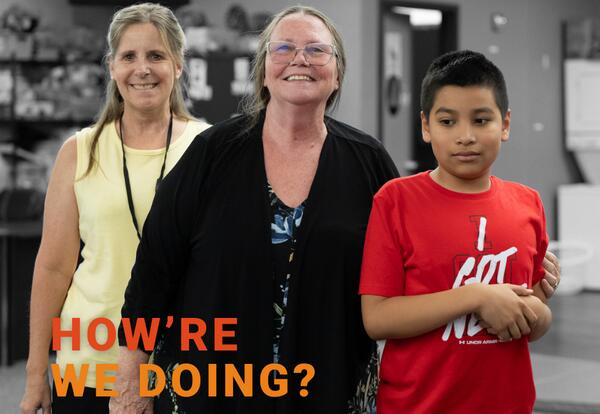
Every year about this time, the State of California publishes a data dashboard to let public school districts know how we’re doing on a number of measures ranging from academic performance to attendance, graduation rates, and more. The color-coded results make it easy to see where we’re thriving and where we still have work to do. This year we have more green than ever. While I definitely care about our overall results, I’m also really interested in our trend line: are we getting better or worse? One reason I’m so happy with this year’s dashboard is because we’re going in the right direction in almost everything.
Graduation Rate & College/Career Readiness (Improved)
When it’s all said and done, one of our primary responsibilities as a school district is to help students graduate from high school and prepare them for whatever’s next, whether that’s college or a career. Our graduation rates, which measure Kelseyville High as well as our continuation school, Ed Donaldson Education Center, moved from orange to green, increasing by 9.1% to a whopping 90.4% overall graduation rate!
College and career readiness is divided into three categories: prepared, approaching prepared, and not prepared. We improved dramatically this year. The percent of students “not prepared” went from 48% to 35.7%. The percent of students “approaching prepared” declined slightly from 21.3% to 19.7%. And the percent of students prepared jumped from 30.7% to 44.6%.
Mathematics and English Language Arts (Improved)
In math, we went from red to orange, improving by 6.8 points in student scores. In English language arts, we went from red all the way to yellow, improving by 12.5 points. As a reference point, 3 points or more of improvement is considered meaningful improvement by the state. Of course, I’d like to be in the blue for everything, but our rate of improvement shows that our hard work is paying off.
English Learner Progress (Declined)
Our overall results in this category declined, but when we dig into the details, we have reason to be hopeful about the future. Last year, we struggled at a couple of our schools, but the middle school had huge growth. This year we have staff at all sites to replicate what worked so well at MVMS, so we expect scores will be going up districtwide next year.
Chronic Absenteeism and Suspension Rate (Improved Slightly)
We know that if students aren’t at school, they are missing out on classroom instruction, so they tend to fall behind. Chronic absenteeism is considered a measure of academic engagement and suspension rate is considered a measure of school climate. These measures aren’t perfect, but they do give us some important information. For chronic absenteeism, we are in the yellow. For suspension rate, we are in the green. We’ll keep working on academic engagement and our school climate and I expect these scores will improve.
The Alphabet Soup of What’s Working: AVID, PBIS, PLCs, CFAs
We’ve been really intentional about providing our students with the kind of support and instruction that will help them be successful.
AVID stands for Advancement Via Individual Determination. It is both a cohesive set of teaching and learning strategies and an elective class at the middle school and high school. AVID provides a ton of engagement strategies, such as higher-level questions to build critical thinking skills. The elective classes provide extra support to first-generation, college-bound students–especially those who are traditionally underserved because of poverty, having English as their second language, or belonging to an under-represented ethnic or cultural group.
PBIS stands for Positive Behavioral Interventions and Supports. This approach utilizes restorative practices over harsh discipline. It focuses on natural consequences, reteaches expectations, and takes advantage of teachable moments.
PLC stands for Professional Learning Committees. Every week, we have early release days so teachers have time to collaborate, review student data, and adjust to students’ changing needs. We also have two instructional coaches districtwide, one for our elementary schools and one for our secondary schools, so our teachers can keep learning and growing.
CFA stands for Common Formative Assessment. These assessments are consistent across each grade level, and they allow us to constantly adjust to the needs of our students. We can see what students have learned and what they haven’t at an individual-student level. We can then determine whether the whole class needs us to re-teach an important concept, or if we just need to support a few kids to be sure they can keep up.
At Kelseyville Unified, our goal is to continually improve–that means all of us. As administrators, we ask ourselves how we can learn and grow and support teachers. As teachers, we ask ourselves how we can learn and grow to support students. And, we encourage our students to invest in their own learning and growth. As we kick off the second half of the school year, I’m excited to see our students continue to thrive.